
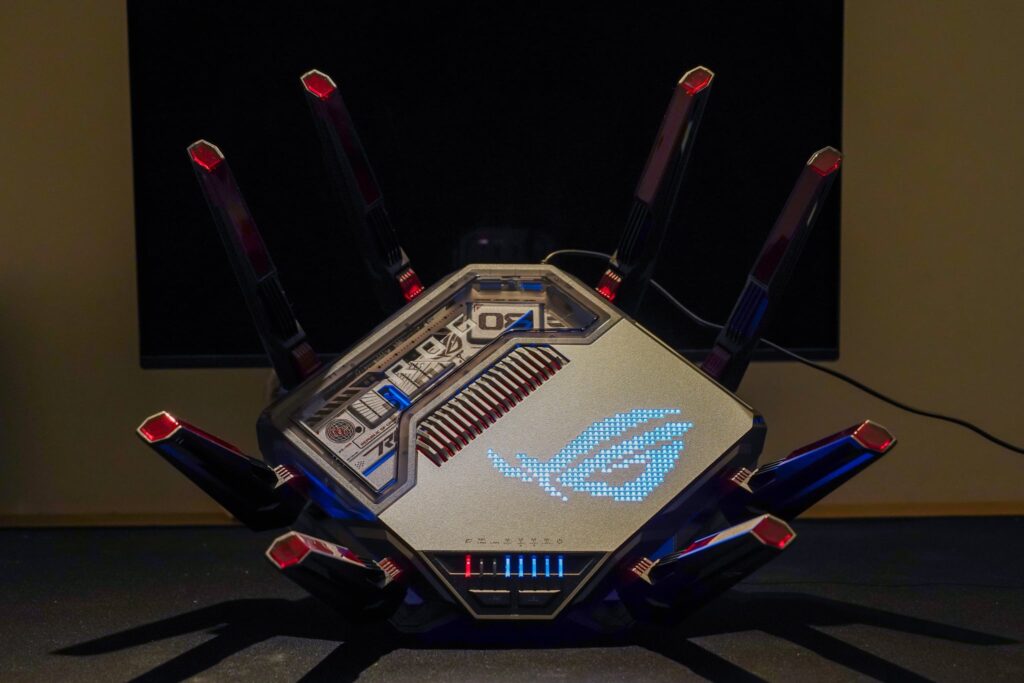
ASUS has always been aggressive when it comes to being first to market with new wireless standards. They were among the first to ship Wi-Fi 6 and Wi-Fi 7 routers and now they’re doing it again with Wi-Fi 8. The ROG Rapture GT-BN98 is the world’s first commercially available Wi-Fi 8 gaming router.
The GT-BN98 is ASUS’s flagship gaming router and the direct generational successor to the GT-BE98. It comes equipped with the latest Wi-Fi 8 BN25000 technology which is a quad-band router with 2.4GHz, dual 5GHz bands, and a single 6GHz band. ASUS has done a total revamp of the firmware and introduced the new Adaptive QoE engine, replacing the older Adaptive QoS system that has been around for several generations of ASUS routers and was starting to show its age.
You may have heard of the GT-BN98 Pro, which is sold in selected North American markets. That model replaced the secondary 5GHz band with an additional 6GHz band operating on the UNII-8 spectrum. Unfortunately, due to regulatory limitations, the UNII-8 band is not approved for use at most of the world outside of North America. Apart from this, everything else between the two models is identical. In practice, having dual 5GHz bands is arguably more useful for most households anyway, since the vast majority of devices we use today still operate on the 5GHz band.
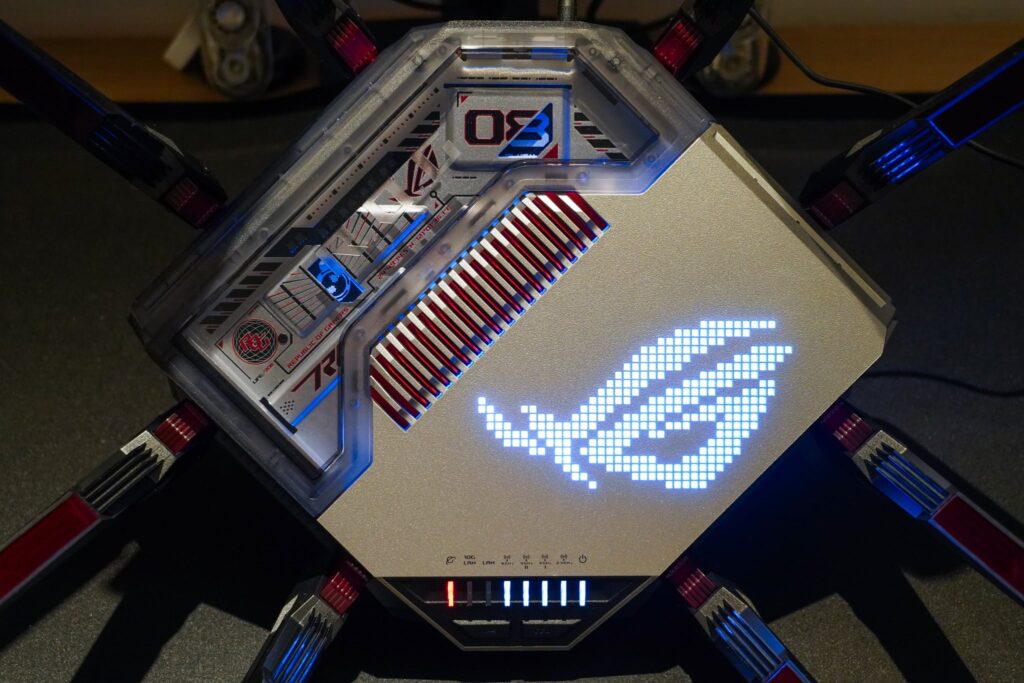
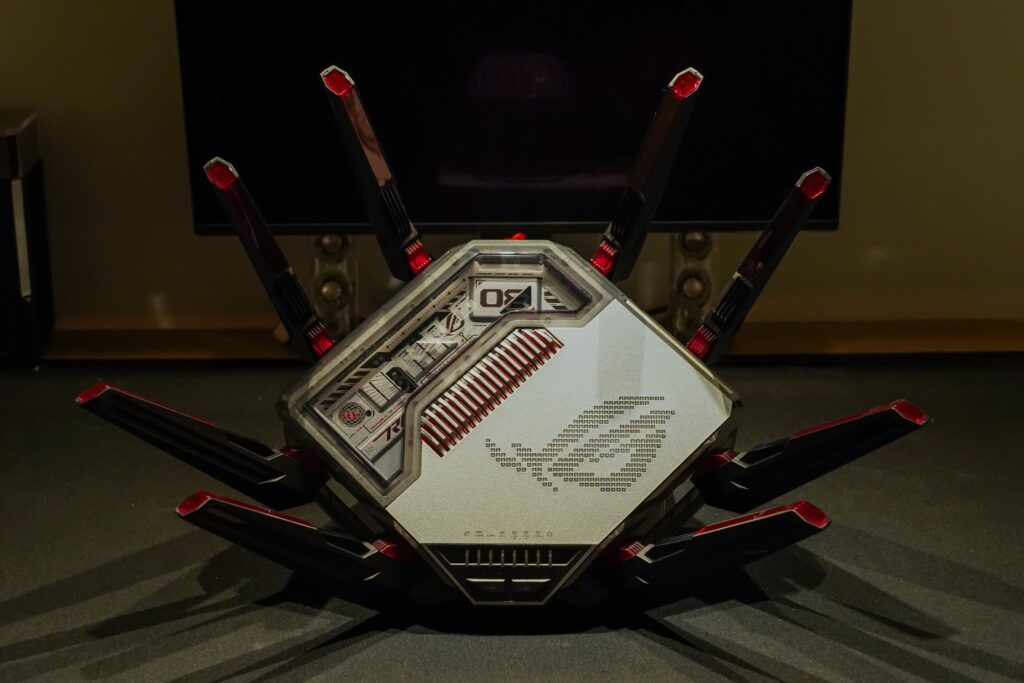
The router is extremely well constructed with very good attention to detail. All the parts fit together precisely, with no creaking, no uneven gaps, and no cheap-feeling plastic. This is the kind of build quality you would expect from a premium product at this price point, and ASUS has delivered. It’s full of fine design details, from the textured surfaces to the aggressive antenna design to the Aura RGB glow. This router is ready impress someone who walked into your gaming room.
ASUS has reused the design of the previous flagship model on the GT-BN98. That said, there are some design tweaks and thermal improvements under the surface to accommodate the more demanding Wi-Fi 8 chipset. ASUS claims a thicker aluminum top plate and an enhanced nanocarbon layer for better heat dissipation. The router is entirely passively cooled and the exposed heatsink on top actually does its job pretty well. Even after extended stress testing, the GT-BN98 stayed within reasonable temperatures without any sign of thermal throttling.

The biggest visual difference would be the finishing of the chassis. ASUS has upgraded to a metallic-looking finish on the GT-BN98, giving it a more premium look compared to the GT-BE98. Unfortunately, they couldn’t use real metal here as it would interfere with the Wi-Fi signal. For those who dare, the Aura RGB lighting is still present and it’s still as vibrant and bright as you’d expect from an ROG product.
One thing I should mention is the sheer size of this router. The GT-BN98 measures roughly 35cm by 35cm and weighs over 2kg. This is not a router you can casually place on a small shelf or a narrow table. You need a proper, dedicated spot for it with enough clearance for the eight antennas to spread out. And don’t even think about wall mounting it. With this kind of size and weight, wall mounting would be a risky proposition anyway. Just make sure you have a sturdy desk or a wide shelf ready before you bring this thing home.
GT-BN98 Hardware Specs
Under the hood, the GT-BN98 packs a 2.6GHz quad-core processor and 2GB of RAM. The quad-band configuration consists of 2.4GHz at 1376Mbps, dual 5GHz bands at 5764Mbps each, and a single 6GHz band hitting 11529Mbps with 320MHz channels, for a combined theoretical throughput of 25,000Mbps. If you think these numbers look familiar, that’s because they are. These are the exact same number as the GT-BE98.
On paper it looks like the same router, but underneath, the Wi-Fi chipsets have all been updated to the latest generation with Wi-Fi 8 (802.11bn) technology. These are completely new silicon, designed from the ground up to support the upcoming standard. While we are still a long way to go before Wi-Fi 8 is officially finalized, the newer chipsets already bring tangible benefits that show up in real-world testing, even with Wi-Fi 7 clients.
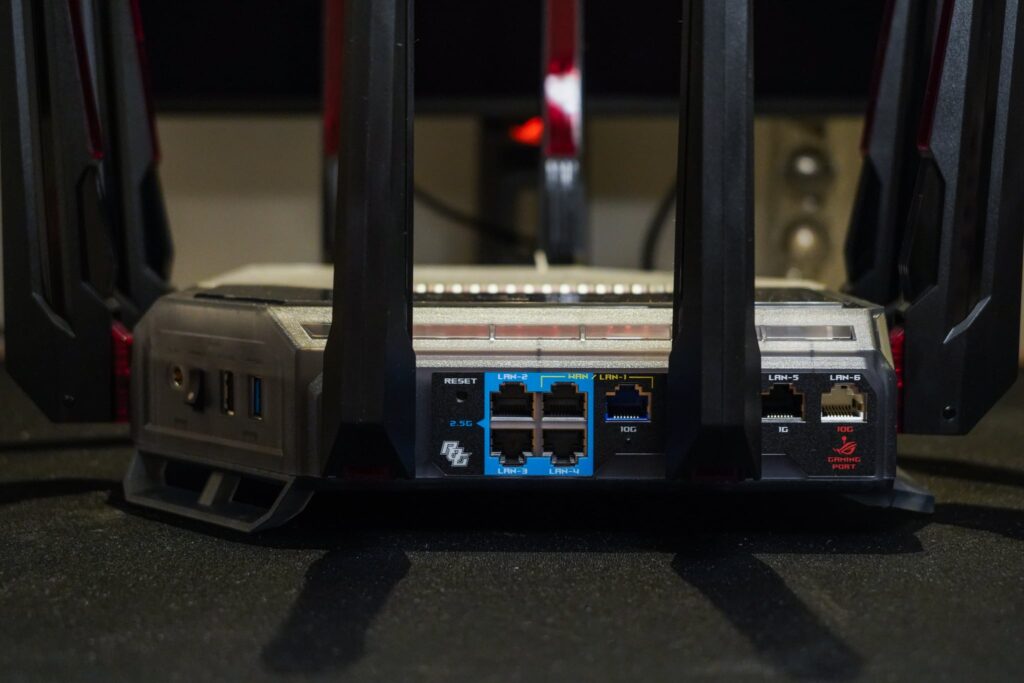
You get two 10G ports, four 2.5G ports, and a single Gigabit port. With the right configuration, you can have up to six LAN ports active on this router as ASUS also gives you the option to configure dual WAN or remap the WAN port as well. USB 3.2 Gen1 and USB 2.0 ports round up the connectivity, letting you plug in external storage for network sharing.
Testing Wi-Fi 8 on GT-BN98
Wi-Fi 8 is all about achieving faster real-world speeds. On paper, there isn’t any physical link rate improvement as even the theoretical maximum link speed is the exact same as the predecessor. But let’s be honest, that number has always been a marketing figure. What actually matters is the speed you get in real-world conditions like from your bedroom two walls away from the router. And that’s exactly where Wi-Fi 8 makes a real difference.
ASUS claims that the GT-BN98 can deliver up to 2x higher median throughput compared to Wi-Fi 7 at mid-to-long range. This is a significant distinction because Wi-Fi marketing has always been obsessed with the best-case scenario. A router that delivers 2400Mbps when you’re standing right in front of it but drops to 100Mbps in the bedroom isn’t very useful. What matters is the speed in the bedroom. If Wi-Fi 8 can genuinely double the median speed at that range, that’s a far more meaningful improvement than any theoretical link rate increase.
And that’s exactly what I’ve experienced with the GT-BN98. When testing the system, the GT-BN98 produced significantly hight Wi-Fi throughput over a distance of two walls compared to the GT-BE98. The improvement at long range was immediately noticeable and consistent across multiple test runs. Of course, this was tested without a Wi-Fi 8 client device since there isn’t any I can find at the point of writing this article in 2026. Instead, I compared two units of the GT-BN98 against two units of the GT-BE98, both configured as a router and a Wi-Fi client.
Wi-Fi 8 on older Devices
This is where it gets interesting. I also compared the GT-BN98 and GT-BE98 using my MacBook M5 Pro, which only supports Wi-Fi 7. Even on a device that can’t take advantage of any Wi-Fi 8 features, I managed to get better performance on the GT-BN98.
On both our short range line-of-sight and long range tests, I experienced more than 10% higher average throughput on the GT-BN98 compared to the GT-BE98, even on my MacBook with just Wi-Fi 7. While it’s not as dramatic as the near-double performance gains when using two Wi-Fi 8 units, it’s still a meaningful improvement that shows the newer routers are benefiting Wi-Fi 7 clients as well, just on a smaller scale.
You might wonder how this is possible if Wi-Fi 8 benefits are supposed to require Wi-Fi 8 on both ends. That’s because the GT-BN98 ships with the latest generation of Wi-Fi radio components, better front-end modules, and a newer Wi-Fi chipset overall. None of these are ever disclosed on the spec sheet. The only way to see the difference is by testing. This is one of the less obvious benefits of upgrading to a newer router, even when your devices don’t support the latest standard.
GT-BE98 Firmware and Features

ASUS has done a really great job on the firmware of the GT-BN98. The newer interface is noticeably more modern and much more responsive than the older ASUSWRT interface that has been around for more than a decade. If you’ve been using ASUS routers for a while, you’ll immediately appreciate how much of a leap this is. The layout and feature set are largely the same, so there’s no learning curve.
While the firmware is refreshed, I am really glad that ASUS continues their privacy-conscious approach with the GT-BN98. There is no cloud dependency and no subscriptions as everything is already included and nothing is locked behind a paywall. I don’t even need to create an ASUS ID to set up and manage this router, which is becoming increasingly rare in 2026. Almost every competing brand now requires an account and a cloud connection just to get started.
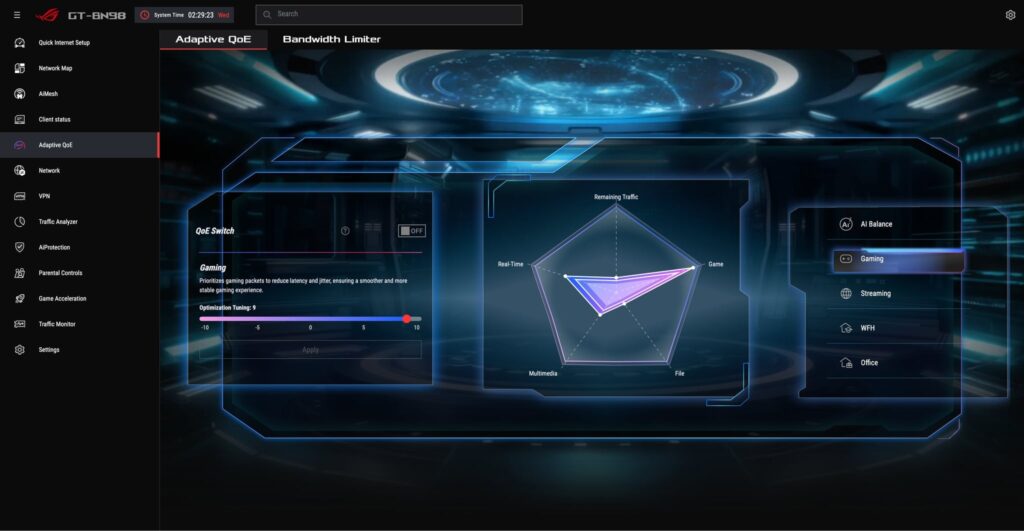
The star of the show is ASUS’s latest Adaptive QoE engine, which replaces the older Adaptive QoS that has been around for several router generations. It’s a shift from Quality of Service to Quality of Experience. Instead of just allocating bandwidth based on device or application priority, the QoE engine actively monitors latency, jitter, and packet loss across your network in real time and makes smarter decisions about traffic management on the fly.
Latency-sensitive applications like online games and WiFi calls are automatically given priority, ensuring they stay smooth even when someone else on the network is downloading a large file or streaming 4K content. For households where multiple people are using the network at the same time, this is probably the single most impactful feature on the GT-BN98. A fast connection means nothing if your game stutters every time someone download a huge file.
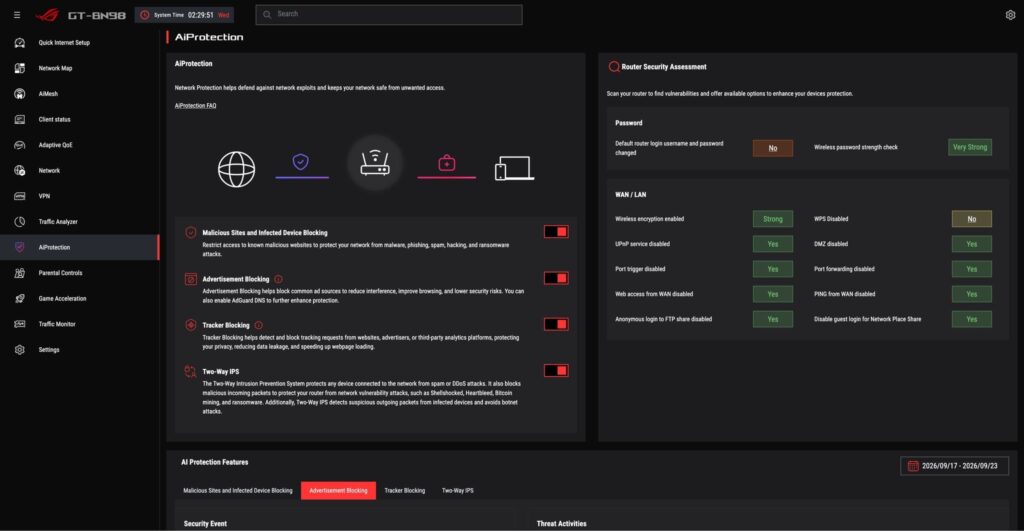
The other big upgrade on this router is the revamped AiProtection feature. While ASUS has actually dropped the “Pro” branding this time around, don’t let that fool you. This is a major upgrade over the previous Trend Micro-powered system that has been on ASUS routers for years. The core security features still work as expected. I tested it against several known malicious websites and the router successfully blocked them all.
What really impressed me though is the new ability to block ads and trackers directly at the router level. This means every device on your network gets ad blocking without needing to install any app or browser extension. ASUS even provides a detailed report showing you how many ads and trackers have been blocked per device, along with a list of the blocked domains. For a feature that’s just included for free with no subscription, this is genuinely impressive and something I hope ASUS brings to their more affordable models as well.
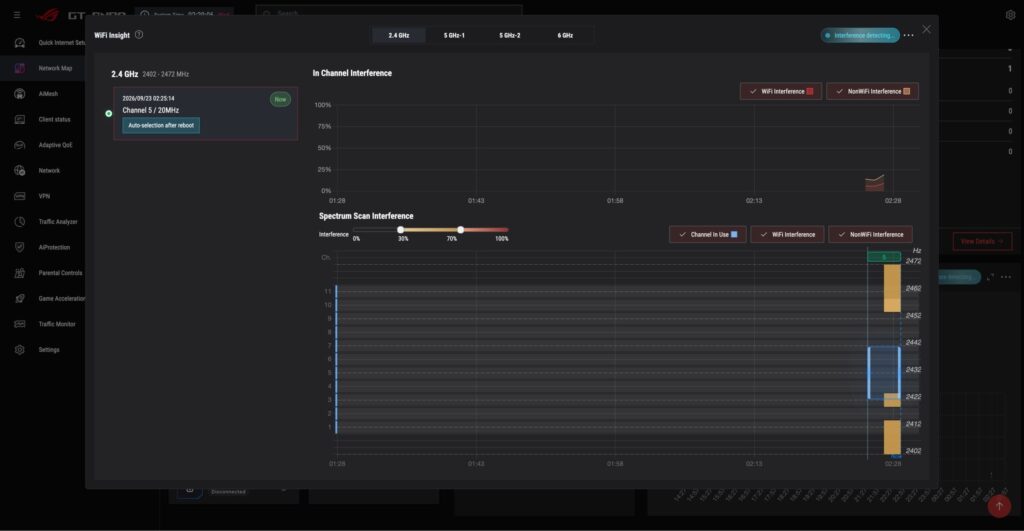
There’s also a new Wi-Fi Insight tool built into the firmware, which is a really useful addition for troubleshooting. The router continuously monitors Wi-Fi interference and channel conditions over the past 24 hours and presents it in a clear, visual timeline. You can actually see the interference pattern and make informed decisions about channel selection.
I am quite impressed by this feature as it actually works as intended. Not only does it detect Wi-Fi interference from neighbouring networks, on the 2.4GHz band it was even able to pick up interference caused by my Zigbee smart home devices. I cross-referenced the configured channel my Zigbee hub operates on and it matched perfectly, proving that the detection is both functional and accurate.
ASUSWRT is also now leveraging this advanced spectrum analysis data to make smarter automatic channel selection decisions. In previous ASUS routers, the auto channel selection would perform a quick one-time scan of the airwaves and pick the least congested channel at that moment. The GT-BN98 can now make channel decisions based on historical record, meaning it understands your interference patterns over time and selects channels that are consistently cleaner rather than just temporarily empty.
Closing Thoughts
The ROG Rapture GT-BN98 is, in many ways, a technology showcase of what’s coming in the future of Wi-Fi. It represents a shift in how wireless networking might evolve, moving away from inflated marketing figures and focusing instead on real, sustainable performance in everyday conditions. But a lot of this is still bleeding edge. The Wi-Fi 8 standard is not finalized, and compatible Wi-Fi 8 client devices will probably not arrive until 2027 at the earliest
That said, even in its current state, the GT-BN98 delivered measurable improvements over the GT-BE98 in our testing, both with Wi-Fi 8 hardware and with regular Wi-Fi 7 clients. The refreshed firmware with the new Adaptive QoE engine, the Wi-Fi Insight tool, and the overall snappier interface are welcome upgrades that you benefit from regardless of what devices you own.
Should you buy the ROG Rapture GT-BN98? If you are in the market for a flagship router and you want the best coverage, the best performance, and the best sustained throughput money can buy, the GT-BN98 is genuinely the best one out there right now. You will be getting a router that already outperforms everything else in its class today, with the promise of getting even better as the ecosystem catches up.